

Introduction: First Impressions Are Made Before Anyone Speaks
Acrylic sign boards Singapore businesses rely on are not just functional. They set the tone. They signal credibility. They tell a visitor whether they have arrived at the right place and whether they can trust the business behind the sign.
When a client walks into your office or a customer enters your retail store, they form an opinion within the first seven seconds. Your signage is the first thing they see — and it communicates your brand’s professionalism before any conversation begins.
That is why acrylic signage has remained the material of choice for offices, clinics, retail stores, and commercial buildings across Singapore for decades — and continues to dominate in 2026.
Signarama CBD produces custom acrylic sign boards for businesses across Singapore’s CBD, commercial, and retail sectors. This guide covers everything you need to know about acrylic signage — from material options and applications to design tips, cost guidance, and the latest trends.
What Are Acrylic Sign Boards in the Singapore Context?
Acrylic — also known by the trade name Perspex — is a transparent thermoplastic called polymethyl methacrylate (PMMA). Manufacturers produce it in sheet form, and signage fabricators cut, print, and finish it into a wide variety of sign types.
Types of Acrylic Used in Signage
Clear Acrylic transmits up to 92% of visible light — clearer than glass. It is ideal for floating signs, backlit displays, and anywhere you want a sleek, invisible-panel effect.
Frosted Acrylic diffuses light evenly and delivers a premium, matte finish. Designers specify it for reception panels, door signs, and privacy partitions where sophistication matters.
Coloured Acrylic comes in hundreds of standard and custom colours. It eliminates the need for printing a background and produces vivid, consistent colour throughout the panel thickness.
Printed Acrylic uses UV or latex printing directly onto the acrylic surface. Signarama CBD uses SwissQprint UV technology, which delivers sharp detail, accurate colour, and outdoor-durable ink adhesion.
Laser-Cut Acrylic allows precise cutting of letters, logos, and shapes from acrylic sheet stock. Laser cutting produces clean, polished edges with no chipping or cracking.
Illuminated Acrylic integrates LED edge lighting or backlit panels. The material’s optical clarity allows light to travel through the panel cleanly, making signs visible in both bright and low-light environments.
Each type serves a specific purpose. Understanding the options helps you specify the right material for each sign in your project.
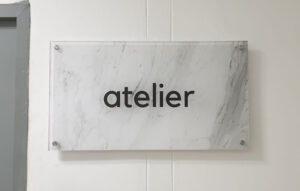
Elegant marble-effect acrylic signage designed for premium retail and hospitality environments.
Why Businesses Choose Acrylic Sign Boards in Singapore
Premium Appearance Without the Premium Price
Acrylic delivers a visual finish that rivals glass and brushed metal — at a fraction of the cost. It photographs well, looks clean under corporate lighting, and maintains its appearance over years of use.
Durability in Singapore’s Climate
Singapore’s heat, humidity, and UV exposure are hard on materials. Acrylic resists yellowing, warping, and moisture absorption far better than PVC or foamboard. Outdoor-rated acrylic with UV-resistant coatings performs reliably in direct sunlight and rain.
Lightweight Construction
Acrylic is roughly half the weight of glass at the same thickness. This reduces installation complexity, wall anchor requirements, and freight costs for large-format signs.
Easy Maintenance
A soft cloth and mild soapy water clean acrylic effectively. Unlike painted surfaces, the colour in printed or cast acrylic does not peel or chip under normal conditions.
Brand Consistency
Printed acrylic reproduces Pantone and brand colours accurately. Businesses with multiple locations can specify the same colour profiles and receive consistent results across every site.
Versatility
Acrylic suits indoor and outdoor applications, wall mounting, standoff mounting, suspended hanging, and freestanding display. One material handles the full range of signage needs in a typical commercial building.
Top Applications of Acrylic Sign Boards in Singapore
Corporate Offices
Reception Signs — The reception area is the first branded space a visitor encounters. Printed or laser-cut acrylic with standoff mounting creates an authoritative, polished brand statement at the front desk.
Lobby Branding — Large-format printed acrylic panels communicate company values, mission statements, or brand imagery at scale. Companies in Marina Bay, Raffles Place, and Tanjong Pagar routinely use lobby acrylic installations to reinforce brand identity.
Mission and Values Walls — Frosted acrylic with vinyl lettering or direct print creates articulate internal branding that resonates with both staff and visitors.
Retail Stores
Store Branding — Acrylic fascia and dimensional lettering give retail storefronts a professional finish that stands out in shopping malls across Orchard Road, VivoCity, and Jewel Changi.
Promotional Displays — Short-turnaround printed acrylic panels update promotions quickly without replacing permanent structures.
Product Display Signs — Clear and frosted acrylic display holders and shelf signs organise product information cleanly without visual clutter.
Healthcare
Clinic Directional Signs — Hospitals and specialist clinics in Singapore use acrylic directory and wayfinding signs because the material cleans easily, maintains a clinical appearance, and holds print colour over extended periods.
Room Identification — Door signs and room number plates in healthcare facilities require legibility, durability, and a hygienic surface. Acrylic meets all three requirements.
Education
School and University Branding — Institutions such as polytechnics, international schools, and private education centres use acrylic for entrance signs, department identification, and award displays.
Campus Wayfinding — Multi-building campuses depend on consistent acrylic directory signs to guide students and visitors efficiently.
Hospitality
Hotels — Room number signs, floor directories, and lobby feature walls in Singapore hotels frequently use acrylic for its premium finish and easy replacement when room numbering changes.
Restaurants and Cafes — Menu boards, queue management signs, and branding panels in food and beverage outlets use backlit and printed acrylic to maintain visual consistency under varied lighting conditions.
Commercial Buildings
Building Directories — Multi-tenant commercial properties in the CBD use acrylic directory systems with interchangeable tenant panels.
Wayfinding Systems — Level identification, lift lobby signs, and emergency exit signage in commercial buildings use acrylic for its legibility, durability, and compliance with building management standards.
Acrylic vs Other Signage Materials
Choosing the right material depends on budget, environment, and the visual result you need. Here is a direct comparison:
| Material | Appearance | Cost (Relative) | Durability | Maintenance | Best Use Case |
|---|---|---|---|---|---|
| Acrylic | Premium, clean | Medium | High | Low | Offices, retail, lobbies |
| Aluminium | Industrial, flat | Medium | Very High | Low | Outdoor, industrial |
| Stainless Steel | Luxury, reflective | High | Very High | Medium | High-end reception, monuments |
| PVC | Functional | Low | Medium | Low | Temporary, budget displays |
| Foamboard | Basic | Very Low | Low | Low | Events, short-term use |
| Glass | Premium, fragile | High | Medium | High | Feature walls, display cases |
Where acrylic wins: For most commercial signage applications in Singapore, acrylic offers the best balance of appearance, durability, and cost. It outperforms PVC and foamboard on longevity. It outperforms glass on safety and weight. It matches aluminium and stainless steel on visual impact for interior applications at a lower cost.
Design Tips for Effective Acrylic Signage
Good acrylic signage starts at the design stage. These principles apply directly to Singapore’s commercial environment.
Logo Placement
Position your logo at the natural eye-level viewing height for your audience — approximately 1,500 mm from the floor for standing visitors. Avoid placing logos in corners or at floor level where they lose impact.
Colour Contrast
White or light-coloured text on dark acrylic — and dark text on clear or frosted acrylic — reads most clearly. Avoid low-contrast combinations. Singapore’s fluorescent office lighting can wash out subtle tonal differences.
Viewing Distance
Design for the distance at which the sign will typically be read. A lobby reception sign read from five metres needs larger type than a door plate read from one metre. As a rule, every metre of viewing distance requires approximately 8 mm of capital letter height for comfortable reading.
Lighting
Plan your lighting before you finalise the sign design. Edge-lit and backlit acrylic signs require the appropriate acrylic grade and thickness. Surface-lit signs need directional lighting to avoid glare on gloss-finish panels.
Font Selection
Select sans-serif typefaces for maximum legibility. Helvetica, Montserrat, and Futura are reliable choices. Avoid decorative scripts for wayfinding and directory signs — they reduce legibility at distance and in low-light conditions.
Thickness Selection
- 3 mm: Door signs, menu boards, lightweight panels
- 5 mm: Reception signs, lobby panels, retail fascia
- 8–10 mm: Feature walls, freestanding displays, dimensional lettering
- 15–20 mm: Premium lobby installations, 3D cut letters
Mounting Methods
Standoff mounting — where the sign floats away from the wall on metal studs — is the most popular choice for corporate offices. It creates a shadow line that adds depth and a premium finish. Flush mounting suits door signs and directional plates. Suspended hanging suits lobby feature installations.
Acrylic Signage Trends in Singapore in 2026
Minimalist Branding
Singapore’s corporate sector continues to favour clean, minimal design. Large areas of negative space, single-colour palettes, and precision laser-cut letterforms characterise the current aesthetic.
Floating Signs with Standoff Mounting
The floating sign — an acrylic panel mounted on brushed metal standoffs — remains the dominant style in law firms, financial institutions, and technology companies across the CBD.
Layered Acrylic
Stacking clear, frosted, and coloured acrylic panels at different depths creates a dimensional effect that photographs well and reads clearly from multiple angles. This technique is increasingly specified for feature reception walls.
LED Backlit Acrylic Signs
Edge-lit and backlit LED acrylic panels add ambient light to lobby and retail environments while keeping the sign legible in all lighting conditions. The technology has become more affordable and the LED lifespan now exceeds 50,000 hours in most quality installations.
Printed Acrylic Graphics
Direct UV printing — Signarama CBD uses SwissQprint technology for this — allows full-colour photographic graphics to be printed directly onto acrylic without vinyl intermediaries. The result is sharper detail, better colour fidelity, and longer outdoor durability.
Sustainable Production Methods
Responsible clients and specifiers increasingly ask about sustainable options. Signarama CBD uses HP Latex inks with Greenguard Gold certification for applications where ink performance and environmental compliance matter. Greenguard Gold certification confirms the inks meet strict chemical emission standards — relevant for healthcare, education, and public sector environments.
Why Signarama CBD for Acrylic Sign Boards Singapore
Signarama CBD is part of Nalla Signs Pte Ltd, operating from Singapore with a focus on precision production and brand-aligned signage outcomes.
In-House Production — Design, printing, cutting, and fabrication happen under one roof. This eliminates subcontracting delays and gives you a single point of accountability for your project.
SwissQprint Printing Technology — SwissQprint UV flatbed printers deliver 1,200 dpi print resolution on acrylic up to 50 mm thick. The result is sharp logos, accurate brand colours, and durable ink adhesion for both indoor and outdoor applications.
Greenguard Gold Certified Inks — HP Latex inks used in production carry Greenguard Gold certification, making them appropriate for sensitive environments including hospitals, schools, and government buildings.
Design Consultation — The team reviews your artwork files, advises on material specification, and flags production issues before your job goes to press. This prevents costly errors on large-format or high-visibility installations.
Installation Services — Signarama CBD provides professional installation for wall-mounted, suspended, and freestanding acrylic sign systems in Singapore commercial buildings.
Corporate Project Experience — The team has delivered acrylic signage projects for corporate offices, retail chains, healthcare facilities, and public sector buildings. This breadth of experience informs material recommendations and installation decisions.
Fast Turnaround — Standard production turnaround for acrylic sign boards is 5–7 working days. Rush options are available for urgent requirements.
Custom Fabrication — Non-standard sizes, custom shapes, layered builds, and integration with aluminium or stainless steel frames are all available within the Signarama CBD production capability.
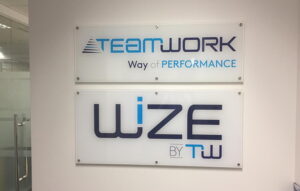
Corporate acrylic branding signs designed for modern office environments.
Frequently Asked Questions
How long do acrylic signs last? Indoor acrylic signs typically last 7–10 years under normal office conditions without significant degradation. Outdoor acrylic with UV-resistant coatings and UV-stable inks can last 5–7 years in Singapore’s tropical climate before requiring replacement or maintenance. Quality of production and ink specification affect longevity significantly.
Are acrylic signs waterproof? Yes. Acrylic sheet material is inherently water-resistant and will not absorb moisture or swell like wood or foamboard. Outdoor signage requires UV-stable inks and appropriate sealant on cut edges to prevent long-term degradation from exposure to direct rain and sunlight.
Can acrylic signs be illuminated? Yes. Acrylic is one of the best materials for illuminated signage. Clear acrylic transmits light cleanly from LED edge sources. Frosted acrylic diffuses backlit LED panels evenly. Printed acrylic with reverse printing on clear substrate creates illuminated graphics with vivid colour when backlit.
How thick should acrylic signage be? For door signs and small plates, 3 mm is standard. Reception signs and lobby panels typically use 5 mm. Large feature installations and dimensional lettering use 8–10 mm or thicker. Thickness affects rigidity, cutting method, and cost. Your signage supplier should recommend thickness based on sign size and mounting method.
How much do acrylic signs cost in Singapore? Pricing depends on size, thickness, finish, printing complexity, and mounting hardware. A standard office door sign in frosted acrylic starts from approximately SGD 80–150. A reception feature wall in printed acrylic with standoff mounting typically ranges from SGD 800 to SGD 3,000 or more depending on size and complexity. Request a quote with specific dimensions for accurate pricing.
Can acrylic sign boards be installed outdoors in Singapore’s weather? Yes, with the right specification. Use UV-stabilised acrylic sheet stock, UV-resistant or UV-printed inks, sealed cut edges, and corrosion-resistant mounting hardware. Avoid mounting acrylic in locations with sustained direct mechanical stress or impact risk. In Singapore’s tropical climate, check installations annually for edge discolouration or ink fading.
What is the difference between acrylic and glass signage? Acrylic weighs roughly half as much as glass, making it safer and easier to install. Acrylic is impact-resistant and will not shatter. Glass offers a slightly higher refractive quality and can feel more premium in high-end environments. However, glass is heavier, more fragile, harder to print on, and significantly more expensive for large-format signage.
What industries use acrylic signs? Acrylic signage is used across virtually every commercial sector in Singapore including corporate offices, retail, healthcare, education, hospitality, logistics, government, and real estate. The material’s combination of appearance, durability, and printability makes it the default choice for most indoor commercial signage requirements.
Can acrylic signs be cut into custom shapes? Yes. Laser cutting and CNC routing allow acrylic to be cut into any shape — corporate logos, arrows, bespoke letterforms, or architectural profiles. Custom shapes cost more than rectangular panels due to the additional cutting time, but they deliver a level of visual differentiation that standard rectangular signs cannot match.
What mounting options are available for acrylic sign boards in Singapore? The main options are: flush wall mounting with adhesive or screws; standoff mounting using metal studs for a floating effect; suspended hanging on cables or rods for ceiling or glass partition installation; and freestanding frames for floor-based displays. Each method suits different environments and design intentions.
How are logos and graphics applied to acrylic signs? There are three main methods: direct UV printing onto the acrylic surface; vinyl application over the acrylic substrate; and reverse printing (printing on the back of clear acrylic so the graphic shows through the front). Direct UV printing with SwissQprint technology produces the highest resolution and best long-term durability.
Do acrylic signs require special cleaning? Use a soft, clean cloth and a mild soapy water solution. Avoid abrasive cloths, scouring pads, acetone, alcohol, or solvent-based cleaners — these scratch or craze the surface. Microfibre cloths work well for regular dusting. Anti-static sprays reduce dust attraction on large panels in office environments.
What is the lead time for acrylic sign boards in Singapore? Standard production and delivery for acrylic sign boards in Singapore is 5–7 working days from artwork approval. Complex projects with fabricated frames, standoff hardware, or multi-panel systems may require 10–14 working days. Rush production is available for time-sensitive requirements at additional cost.
Can acrylic signs be updated or replaced easily? Individual acrylic panels in modular directory and room sign systems can be replaced without disturbing the frame or surrounding signage. This is a significant advantage over fixed-format signs in buildings with frequent tenant changes or internal reorganisations.
Are acrylic signs suitable for healthcare environments? Yes. Acrylic meets the hygiene requirements of healthcare environments. The surface is non-porous, easy to wipe clean with standard clinical disinfectants, and does not harbour bacteria when maintained correctly. For healthcare projects, specify inks with Greenguard Gold certification to meet indoor air quality requirements.
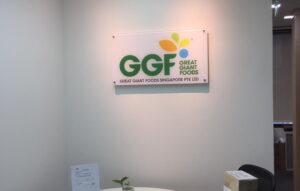
Reception branding sign displaying company identity using premium acrylic materials.
Quick Answers About Acrylic Sign Boards in Singapore
What are acrylic sign boards? Acrylic sign boards are signage panels made from PMMA plastic, available in clear, frosted, coloured, and printed finishes. Businesses use them for reception signs, lobby branding, directory systems, and wayfinding across corporate, retail, and healthcare environments.
Are acrylic signs durable? Yes. Acrylic resists moisture, UV exposure, and impact better than PVC or foamboard. Indoor acrylic signs last 7–10 years. Outdoor signs with UV-stable inks and coatings last 5–7 years in Singapore’s tropical climate.
Can acrylic signs be used outdoors? Yes, with UV-stabilised acrylic sheet and UV-resistant inks. Sealed edges and corrosion-resistant mounting hardware extend outdoor performance. Annual inspection is recommended in Singapore’s high-humidity environment.
What is the lifespan of acrylic signage in Singapore? Indoor acrylic signage lasts 7–10 years under normal conditions. Outdoor acrylic with appropriate treatment lasts 5–7 years before requiring refurbishment. Production quality and ink specification determine actual lifespan.
What businesses use acrylic signage? Corporate offices, retail stores, clinics, hospitals, schools, hotels, restaurants, and commercial buildings. Acrylic suits any business that needs professional, durable signage with accurate brand colours and clean visual presentation.
Call to Action
Looking for Acrylic Sign Boards in Singapore?
Speak with Signarama CBD today for a free consultation and discover how custom acrylic signage can elevate your brand presence.
Visit signarama-sea.com/acrylic-sign-boards or contact our team directly to discuss your project requirements and receive a detailed quote.